

What occupational, physical, and speech therapy actually do for kids — and how to know if your child might benefit
Sponsored by Move U Pediatric Therapy
Author Lexi Waddell
If you’ve ever caught yourself wondering whether your child’s struggle is “just a phase” or something more, you’ve already asked the question most parents bring to us first. As the holidays approach and routines get busier, those questions tend to surface more — a meltdown at grandma’s house, a meal your child won’t touch, a milestone that still hasn’t clicked. Rather than answer them one at a time, we thought it would help to gather the questions we hear most often from families and walk through them together, so you have a clearer picture of what pediatric therapy actually is, and whether it might be worth exploring for your child.
“What’s the difference between occupational, physical, and speech therapy?”
This is usually the first question, and it makes sense — the three often get lumped together, but each one focuses on a different part of your child’s growth.
Physical therapy centers on movement — helping kids build the strength, balance, and coordination behind milestones like rolling, crawling, walking, and jumping. If your child seems delayed in gross motor skills, tires quickly during play, or struggles with balance and posture, PT is usually the starting point.
Occupational therapy takes a broader view of daily life. Rather than one skill area, OT looks at everything a child needs to do to participate fully — playing, learning, getting dressed, managing emotions, and handling the sensory experience of the world around them. It’s often the therapy that addresses fine motor skills like handwriting and utensil use, along with regulation and attention.
Speech therapy goes well beyond pronunciation. Speech-language pathologists help children with language development, understanding and following directions, social communication, and — something many parents are surprised to learn — feeding and oral motor skills, including picky eating and difficulty with textures.
In practice, these three often overlap. A child who struggles to communicate may also struggle to regulate their emotions; a child with low muscle tone may also have trouble with the fine motor demands of handwriting. That’s part of why so many families end up working with more than one type of therapist, sometimes at the same time.

“Is this something my child will just grow out of?”
Sometimes, yes — plenty of quirks and delays resolve on their own with time. But this is exactly the question therapy that is built to help answer. An evaluation isn’t a long-term commitment; it’s simply a way to find out whether your child’s struggle is likely to resolve naturally or whether some extra support now could help them catch up sooner, with a lot less frustration along the way for both of you.
Early support matters because skills build on each other. A toddler who struggles with core strength may later struggle to sit at a table for family dinner. A child who can’t yet express frustration in words may express it through a meltdown instead. Addressing the root skill early tends to prevent the frustration from compounding.
“Do I need a diagnosis or a doctor’s referral to get started?”
For occupational and physical therapy, no. Speech therapy does require a referral and is typically given by a primary care doctor or pediatrician. Many families come to us with nothing more than a feeling that something is harder for their child than it should be — no diagnosis, no referral, just a question worth answering. If that’s where you are, that’s reason enough to reach out and start a conversation.
“What actually happens in a session?”
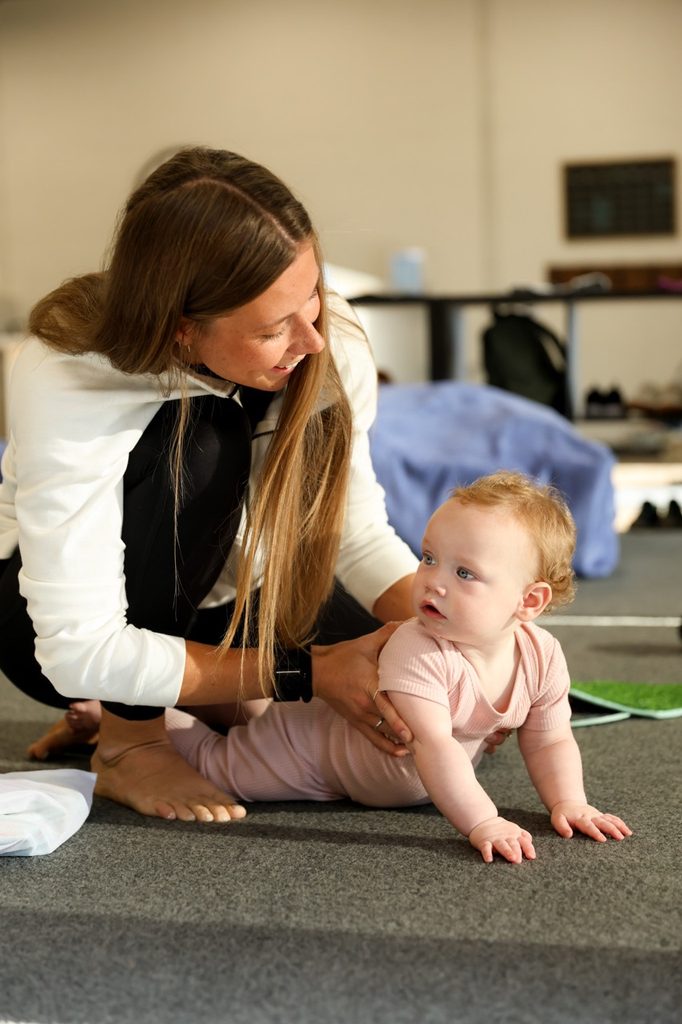
We’ve created a welcoming, and playful environment at Move U so kids can look forward to coming to our space and growing. Pediatric therapy — whether PT, OT, or speech — works best through play, because play is how kids naturally build skills and stay engaged. A session might involve an obstacle course, a swing, climbing on the rock wall, jumping on the trampoline, or a game of catch, all built around specific goals your therapist is tracking behind the scenes.
At Move U, this looks like a child-led, relationship-based approach, informed by the DIRFloortime® model. Instead of rigid drills or reward charts, our therapists follow your child’s interests and natural motivation to connect, using that connection as the foundation for building new skills — whether that’s crawling, forming sentences, tolerating a new food, or managing a big emotion.
“My child seems fine most of the time — these are just everyday struggles, right?”
Often, yes, everyday struggles are exactly what bring families to therapy — and that’s not a bad thing. You don’t need a “big” concern to ask a question. Some of the most common reasons parents reach out include:
Meltdowns during transitions, like leaving the park or getting out the door in the morning. Picky eating that goes beyond preference into daily mealtime battles. Sensitivity to tags, textures, loud noises, or messy hands. Avoidance of writing or drawing tasks. Trouble focusing or sitting still. Speech that’s harder to understand than expected for their age. Big emotional reactions to noisy, busy environments — birthday parties, family gatherings, or holiday events that end in tears.
What connects nearly all of these is that they’re often a sign of an underlying skill that hasn’t quite caught up yet — a body still learning to regulate its senses, a mouth still learning to form new sounds, muscles still building the strength for a new milestone. Once therapy addresses that underlying piece, the everyday struggle usually eases too.
“How does therapy help with emotional regulation specifically?”
This is one of the more overlooked benefits of pediatric therapy, and one of the most valuable. Emotional regulation — the ability to notice a feeling and manage it without shutting down or exploding — isn’t something kids are born knowing how to do. It’s a skill, built the same way physical or communication skills are: through practice, modeling, and the right support.
Occupational therapists often use sensory-based strategies, like movement, deep pressure, or calming activities, to help kids recognize their own rising frustration before it becomes a full meltdown. Speech therapists help by giving kids the words to express needs and feelings instead of resorting to behavior to communicate them. Physical therapists build the body confidence that lets kids engage in play without frustration derailing the experience. Together, these approaches give children more tools to stay regulated — and a regulated child is a child who’s more available to learn, connect, and enjoy their day.
“Will I be involved, or does therapy just happen to my child?”
You’re a central part of the process, not a bystander. Every family walks away with practical strategies to use at home — not just a recap of what happened in the session. Skill-building doesn’t stop when the session ends, and the more it carries into everyday routines, the faster progress tends to show up.
“How long does therapy usually take?”
It depends entirely on the child and the goal. Some families come for a focused season to work through one specific challenge — a feeding transition, a motor delay, an articulation issue — while others benefit from longer-term support as new goals emerge. Your therapist will be honest with you about progress and timelines along the way, so you always know where things stand.
If You’re Still Wondering
If you’ve read this far nodding along to more than one question, that’s worth paying attention to. You don’t need a diagnosis, a referral, or a “big enough” concern to start the conversation — just the sense that something could be a little easier for your child than it currently is.
At Move U Pediatric Therapy in Sioux Falls, our occupational, physical, and speech therapists work together to help children build the skills they need to move, communicate, regulate their emotions, and participate confidently in everyday life — all through playful, child-led, highly skilled care.
📞 Call (605) 409-9533 or visit www.themoveu.com to schedule an evaluation and get your questions answered.

Lexi Waddell is Co-Owner and Head of Development at Move U. Born and raised in Rapid City, she now calls Sioux Falls home with her husband. With a heart for kids, Lexi leads development and client experience initiatives, helping Move U and Empower U better serve the community’s healthcare needs.


