

Sponsored by The South Dakota Safety Council
The South Dakota Safety Council wants to remind parents that as students head back to the classroom, roadways become busier with school buses, young pedestrians, bicyclists, and parents navigating drop-off and pick-up lines. This increase in traffic makes it more important than ever for everyone to work together to keep children safe.
According to the National Highway Traffic Safety Administration (NHTSA), school buses are among the safest vehicles on the road, but children remain at risk when boarding, exiting, and crossing streets near buses. The National Safety Council (NSC) also notes that the most dangerous times for students are before and after school when traffic is heaviest.
Drivers Play a Critical Role
Motorists should remain alert whenever traveling through neighborhoods, residential streets, and school zones. Children can be unpredictable, often crossing between parked cars or entering roadways unexpectedly.
To help keep students safe, drivers should:
- Slow down and obey all posted school zone speed limits.
- Watch carefully for children walking or riding bicycles, especially during arrival and dismissal times.
- Never pass a stopped school bus displaying flashing red lights and an extended stop arm. In every state, drivers must stop under specific circumstances to protect children entering or exiting the bus.
- Stop for crossing guards and school patrol officers directing traffic.
- Never block crosswalks or double-park, which can force children into traffic and reduce visibility for everyone.
- Leave plenty of space behind school buses. The 10-foot area surrounding a bus is considered the most dangerous zone for children.
Drivers should also eliminate distractions by putting away cell phones and focusing their full attention on the road.
Teaching Children Safe Walking Habits
Parents play an important role in helping children become safe pedestrians. Practicing the route to school and reinforcing basic safety habits can significantly reduce the risk of injury.
Children should be taught to:
- Walk on sidewalks whenever possible. If no sidewalk is available, walk facing oncoming traffic.
- Stop, look left, right, and left again before crossing any street, and continue looking while crossing.
- Cross only at designated crosswalks or intersections.
- Make eye contact with drivers before stepping into the roadway.
- Never run into the street or cross between parked vehicles.
- Stay alert and avoid distractions by putting away phones and removing headphones while walking near traffic.
Safety experts also recommend that children younger than 10 cross the street with an adult, as younger children often have difficulty judging vehicle speed and distance.
School Bus Safety Starts Before Boarding
School buses are designed with safety in mind, but students must follow proper procedures when getting on and off the bus.
Parents should remind children to:
- Arrive at the bus stop at least five minutes before the scheduled pickup time.
- Wait at least 10 feet—or about five giant steps—from the curb until the bus comes to a complete stop.
- Board only after the driver signals it is safe.
- Stay seated and face forward during the ride.
- After exiting, walk at least 10 feet in front of the bus before crossing so the driver can clearly see them.
- Look left, right, and left again before crossing the street.
Sharing the Road with Young Cyclists
Children riding bicycles often have difficulty judging traffic situations. Drivers should exercise extra caution by:
- Allowing at least three feet of space when passing cyclists.
- Checking mirrors carefully before opening vehicle doors.
- Watching for bicycles emerging from driveways or behind parked cars.
- Yielding appropriately when turning at intersections.

Set the Example
Children learn by watching the adults around them. Parents, caregivers, and drivers can reinforce safe habits by modeling responsible behavior.
Simple actions such as putting away phones while walking or driving, obeying traffic laws, yielding to pedestrians, and slowing down in school zones demonstrate the importance of safety and encourage children to do the same.
Pull out:
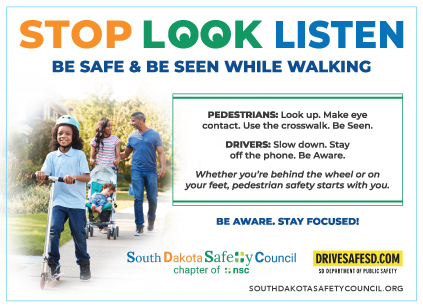
Pedestrians: Look up. Make eye contact. Use the crosswalk. Be Seen.
Drivers: Slow down. Say off the phone. Be Aware
Whether you are behind the wheel or on your feet, pedestrian safety starts with you.
A Shared Responsibility
Back-to-school season brings excitement for students and families, but it also requires increased awareness from everyone on the road. Whether driving, walking, biking, or riding the bus, following basic safety practices can help prevent injuries and save lives.
By slowing down, staying alert, and making safety a daily habit, communities can help ensure every child arrives at school—and returns home—safely every day.
Learn More, Check out these websites!
South Dakota Office of Highway Safety
About the South Dakota Safety Council:
Since 1949, the South Dakota Safety Council has provided programs and services to help employees and workers, families and communities prevent injury. We are committed to the safety of all South Dakotans at work, on the road, at home and at play, through education and training and community events.